For centuries, the diamond has been an unparalleled symbol of love, luxury, and permanence. Its captivating sparkle has mesmerized royalty and adorned the most discerning individuals, making it the ultimate gemstone. But behind this fiery brilliance lies a precise science. The true beauty and value of a diamond are not a matter of chance, but are determined by a universal language of quality known as the 4 Cs.
Understanding this language is the single most important step in making a wise and confident diamond jewelry investment. It empowers you to look beyond the surface and appreciate the intricate factors that create a diamond’s magic. This expert diamond quality guide will demystify the 4 Cs—Cut, Color, Clarity, and Carat—transforming you from a simple admirer into a knowledgeable connoisseur. Whether you are choosing an engagement ring or a timeless pair of earrings, this knowledge is your key to selecting a diamond that is not only breathtakingly beautiful but also a worthy and enduring asset.
The Foundation of Diamond Value – The 4 Cs
To bring consistency and a universal standard to the diamond industry, the Gemological Institute of America (GIA) created the 4 Cs grading system in the mid-20th century. Today, it is the globally accepted methodology for assessing a diamond’s quality. It is crucial to understand that these four factors are not independent; they work in concert to create the unique personality, brilliance, and ultimate value of each stone. A diamond’s final beauty is a delicate interplay between these characteristics.
The 4 Cs are:
-
Cut: The quality of a diamond’s angles and facets, which determines its sparkle.
-
Color: The degree of colorlessness in a white diamond.
-
Clarity: The measure of a diamond’s purity, assessing its natural imperfections.
-
Carat: The weight of the diamond.
While many people first ask about a diamond’s carat weight, seasoned experts know that the other Cs, particularly the Cut, have a far greater impact on a diamond’s visual beauty. A smaller diamond with a superior cut will outshine a larger diamond with a poor cut every time. Let’s delve into each of these critical factors.
Section 2: Cut – The Most Important 'C’
Of all the 4 Cs of diamonds, the Cut is unanimously considered the most important by gemologists. It is also the most complex. A common misconception is that „Cut” refers to a diamond’s shape (such as round, princess, or pear). In reality, a diamond’s Cut grade assesses the quality of its craftsmanship—the precise angles, proportions, symmetry, and finish of its facets. This human element is what unlocks a diamond’s potential to interact with light.
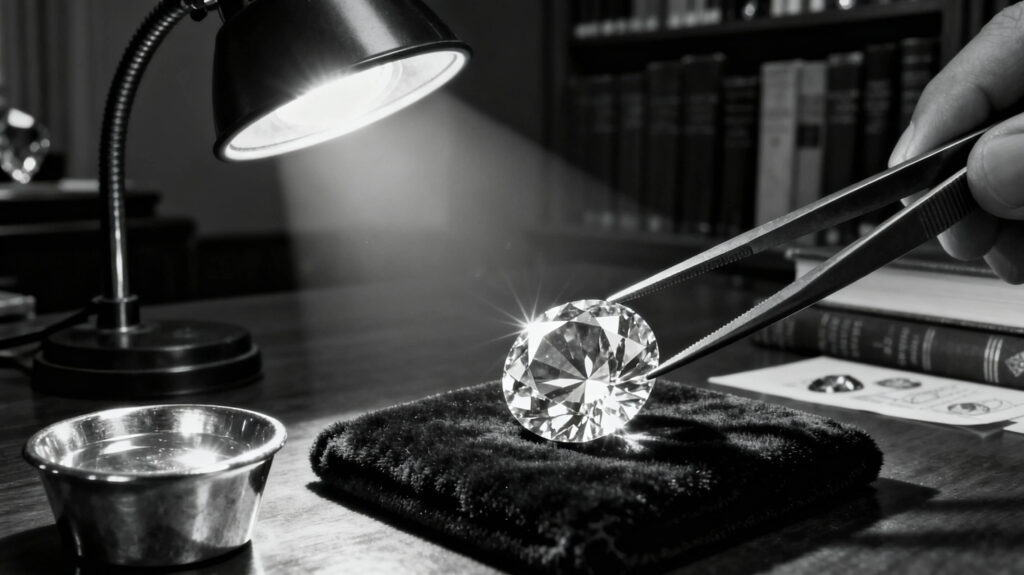
A masterfully cut diamond acts like a miniature hall of mirrors. It captures light entering from above, bounces it around its internal facets, and reflects it back out through the top, creating a dazzling display. This light performance is comprised of three key attributes:
-
Brilliance: The intense white light that reflects from the diamond.
-
Fire: The spectacular flashes of color that are dispersed from the light.
-
Scintillation: The play of light and shadow, or the sparkle, that occurs as the diamond moves.
The GIA grades the cut of a round brilliant diamond on a scale from Excellent to Poor:
-
Excellent: The highest grade, representing the top tier of craftsmanship. These diamonds reflect the maximum amount of light, creating exceptional brilliance and fire.
-
Very Good: These diamonds reflect most of the light, offering outstanding sparkle at a slightly lower price point than Excellent.
-
Good: A good quality cut that reflects a significant amount of light, representing a solid value choice.
-
Fair & Poor: These cuts allow a noticeable amount of light to „leak” out of the bottom or sides of the diamond, resulting in a dull or glassy appearance.
When choosing a diamond, never compromise on the Cut. It has the single greatest influence on a diamond’s beauty and sparkle. An Excellent or Very Good cut can even make a diamond appear larger than its actual carat weight and can help mask slight inclusions or color tints. It is the wisest place to allocate your budget for a truly breathtaking luxury diamond jewelry piece.
Section 3: Color – The Absence of Hue
When we speak of a diamond’s Color, we are typically referring to the absence of color in a white diamond. A chemically pure and structurally perfect diamond has no hue, like a drop of pure water, and is therefore incredibly rare and valuable. The GIA’s diamond color and clarity scale begins with the letter D, representing a perfectly colorless diamond, and continues to Z, which has a noticeable light yellow or brown tint.
The GIA Color Scale is categorized as follows:
-
Colorless (D-F): The rarest and most valuable. The difference between D, E, and F is so subtle it is typically only detectable by a trained gemologist under controlled lighting.
-
Near Colorless (G-J): These diamonds offer exceptional value. Their color is typically unnoticeable to the untrained eye once set in jewelry, yet they are priced significantly lower than the colorless grades.
-
Faint (K-M): A slight, warm tint is visible to the naked eye.
-
Very Light / Light (N-Z): A noticeable yellow or brown tint.
The metal of the setting can significantly influence how color is perceived. A platinum or white gold setting will reveal the slightest hint of color, making a D-F or G-H grade a good choice. Conversely, a yellow gold setting can beautifully complement and even mask the warm tones of a diamond in the I, J, or K range, making it a savvy choice for those who love a warmer look. When how to buy a diamond, finding the „sweet spot” in the G-J range often provides the best balance of beauty and value for a diamond that appears colorless to the eye.
Section 4: Clarity – A Measure of Purity
Diamond Clarity is a measure of the stone’s purity. It refers to the presence and visual appearance of internal characteristics called „inclusions” and external blemishes. These are nature’s tiny fingerprints, formed deep within the earth as the diamond crystalized. While a flawless diamond is the pinnacle of rarity, many inclusions are microscopic and do not affect the diamond’s beauty in any way.
The GIA Clarity Scale has 11 grades:
-
Flawless (FL): No inclusions or blemishes visible under 10x magnification.
-
Internally Flawless (IF): No inclusions, only minor blemishes visible under 10x magnification.
-
Very, Very Slightly Included (VVS1, VVS2): Inclusions are so slight they are difficult for a skilled grader to see under 10x magnification.
-
Very Slightly Included (VS1, VS2): Inclusions are minor and range from difficult to somewhat easy to see under 10x magnification.
-
Slightly Included (SI1, SI2): Inclusions are noticeable under 10x magnification.
-
Included (I1, I2, I3): Inclusions are obvious under 10x magnification and may affect transparency and brilliance.
The most important concept in clarity is „eye-clean.” An eye-clean diamond has no inclusions visible to the naked eye. This is typically true for diamonds in the VS and VVS grades, and often for diamonds in the SI1 grade. Since flawless diamonds are exceptionally rare and command a premium price, choosing an eye-clean diamond in the VS or SI1 range is one of the smartest ways to allocate your budget. You are paying for a diamond that is visually perfect without the premium price of microscopic perfection.
Section 5: Carat – The Measure of Weight
Carat is perhaps the most famous of the 4 Cs, yet it is often misunderstood. Diamond carat weight is a measure of weight, not size. One carat is equivalent to 200 milligrams (0.2 grams). While a heavier diamond will generally be larger, the stone’s visual size is also influenced by its cut and shape. A well-cut diamond with a wider table can appear larger than a poorly cut diamond of the same carat weight.
It is important to understand that diamond prices increase exponentially, not linearly, as carat weight goes up. This is because larger diamonds are significantly rarer. The price jumps are most pronounced at key „magic sizes,” such as 0.50 ct, 1.00 ct, and 1.50 ct.
This creates a savvy buying opportunity. If you are looking for a one-carat diamond, consider choosing a stone that weighs just below that magic mark, for example, 0.95 carats. The visual size difference will be imperceptible, but the price difference can be substantial—often as much as 15-20%. This strategy allows you to maximize size for your budget or to allocate those savings toward a higher grade in the all-important Cut or Color categories.
Section 6: Beyond the 4 Cs: The Importance of Certification
The 4 Cs are only as reliable as the laboratory that grades them. A diamond grading report, or certificate, is the blueprint of your diamond. It is an independent, scientific assessment of the stone’s quality. However, not all lab reports are created equal.
The GIA (Gemological Institute of America) is universally recognized as the gold standard in the diamond industry. It is a non-profit institution with the strictest, most consistent, and most respected grading standards in the world. A GIA certification is not just an appraisal or a piece of paper; it is your ultimate guarantee of the diamond’s quality and your protection as a consumer. A diamond graded by a less reputable lab as a 'G’ color, for instance, might only receive an 'I’ color grade from the GIA.
When making a significant diamond jewelry investment, insist on a GIA certificate. It ensures that you are getting exactly what you pay for and provides the verifiable documentation necessary for insurance and future resale.
Frequently Asked Questions
Q1: Which of the 4 Cs is the most important when buying a diamond?
A: Cut is universally considered the most important factor. It has the greatest impact on a diamond’s sparkle and overall beauty. A well-cut diamond can appear larger and can mask minor imperfections in color and clarity.
Q2: What is an „eye-clean” diamond and why does it matter?
A: An „eye-clean” diamond has no inclusions or blemishes that are visible to the naked eye. This is a key concept for value, as you can purchase a visually flawless diamond (often in the VS or SI clarity range) without paying the premium price for a technically flawless (FL/IF) stone.
Q3: Does the shape of a diamond (e.g., pear, emerald) affect its quality?
A: Shape is a matter of personal preference and is distinct from the Cut grade. However, the quality of the cut within that shape is crucial. The GIA provides full Cut grades only for round brilliant diamonds, but a certificate for a fancy shape will still assess its polish and symmetry, which are key indicators of its craftsmanship.
Q4: Why is a GIA certificate so important?
A: A GIA certificate is the most respected and unbiased assessment of a diamond’s quality in the world. It guarantees that the 4 Cs have been graded to the strictest standards, protecting your investment and ensuring you are paying a fair price for the true quality of the stone.
Conclusion
Understanding the 4 Cs transforms the process of buying a diamond from an intimidating task into an exciting and confident journey. It empowers you to appreciate the nuanced beauty of each stone and to make an intelligent diamond jewelry investment that aligns with your priorities and budget. A truly spectacular diamond is a harmonious balance of all four factors, expertly cut to unlock its inner fire. By prioritizing a superior Cut and seeking a GIA certificate, you can be assured of acquiring a piece of timeless beauty that will bring joy for a lifetime and beyond.
Explore Venier’s curated collection of GIA-certified luxury diamond jewelry and find the perfect, brilliant expression of your story.